ABOUT KENNYWOOD |
ON THIS PAGE: Gate Admission Pricing Park Map General Information Kennywood History Coaster History |
2013 GATE ADMISSION PRICES (regular summer season)
| FunDay Pass (over 46" tall to age 54) | $39.99* |
| Jr. FunDay Pass (under 46") | $26.99* |
| Sr. FunDay Pass (age 55+) | $19.99* |
| Night Rider Pass (after 5pm) | $24.99* |
| Sr. Night Rider Pass (age 55+ after 5pm) | $12.99* |
| Kids age 2 and under | FREE |
VIP TOURS ("front of the line passes") SKYCOASTER Info and Prices
Military Discount
Military members and their dependents can show their valid Military Photo ID any day during the 2013 regular operating season at Kennywood's front gate and purchase a discounted FunDay Pass at the prices listed below. The discount is only valid for the ID holder. The following Military Photo IDs will be accepted:
- Common Access Card (CAC)
- Tan Uniformed Services ID Card
- Red Uniformed Services ID Card
- Blue Uniformed Services ID Card
- Green Uniformed Services ID Card
- Veteran ID Card
| Military FunDay | $20.00* |
| Military Jr. FunDay (under 46") | $20.00* |
| Military Sr. FunDay (55+) | $15.00* |
| Military NightRider (after 5pm) | $15.00* |
| Military Sr. NightRider (55+) | $10.00* |
*All tickets purchased at Kennywood are plus a $1 amusement tax.
Special Event Ticket Information:
PHANTOM FRIGHT NIGHTS | HOLIDAY LIGHTS
PARK MAP
GENERAL INFORMATION
Peanut/Food Allergies??
Kennywood does not use peanut oil for the cooking/frying of any food products. We do use peanuts for toppings for ice cream and have peanuts at the candy store. If you have specific questions about our food products, please stop by the Service Center and ask to speak to a Food & Beverage Manager. We'll be happy to answer your questions.
For Your Safety and Security:
All Guests, Team Members and Management must pass through metal detectors at the entrance gate, and all bags, purses and coolers are subject to search.
Minors (anyone under the age of 18):
We strongly recommend that Minors (under 18) be accompanied by an adult. Park does not assume any responsibility or liability
for unattended minors.
What if it rains? ("Rain Checks")
We will provide a Rain Check (return visit ticket) if a majority of the rides are shut down for a continuous 2 hour period that results in Kennywood closing. In such a case, Kennywood will make announcements regarding how to obtain a Rain Check. This is done at the discretion of management. Rain Checks are not available on request. Rain Checks are not issued to season pass holders. Guests should retain their ticket stubs as these will be required if Rain Checks are issued later in the day. Refunds are not issued.
The Best Time to make a new memory:
We believe that any day is a great day to come to Kennywood! However, the lightest crowds tend to be on Sundays in May (closed first Sunday in May) or June, most any weekday throughout the summer and Memorial Day. Days that the weather forecast calls for some rain can be the best days to visit. The rain scares away those looking for "picture perfect" days, opening the doors for those who can have fun in spite of a few raindrops. And, if we have to close early because of bad weather, we'll provide a return visit ticket to all those in the park with the exception of season pass holders.
Be sure to check our special events!
Rent Wheelchairs, strollers and wagons:
At the main entrance, you can rent wheelchairs, electric scooters, strollers and wagons.
Proper Guest Conduct and Dress:
Kennywood is a family park, and as such does not permit any overtly offensive behavior, language, or clothing. This includes, but is not limited to, profanity, clothing with hateful messages, pornography, vulgarity, illegal acts, and/or divisive political messages.
Kennywood Smoking Policy:
Kennywood is a limited smoking facility. In compliance with the new smoking regulations enacted by Allegheny County, smoking is not permitted inside any building, restaurant or restroom. In addition, smoking is not permitted on park midways, eating areas, ride queue lines, or in Kiddieland. For the convenience of Guests who smoke, smoking is permitted in the following areas only:
- Main Gate Area
- Gazebo near Dancing Waters
- Behind Noah's Ark
- Phantom Entrance Area
- Toy Store at Lost Kennywood Entrance
- Lost Kennywood Restroom Area
- Thunderbolt Restroom Area
- Main Show Area
- Between Cafe and Carousel
- Aero 360, by the Lagoon
- Paratrooper, by the Lagoon
- Across from Pavilion 1 and 2
- Between Pavilions 21 and 24
Signs, cigarette receptacles and blue benches identify these areas. Thank you for your cooperation.
Directions and Accommodations:
Please visit our Directions page for directions to our park from all different areas. Also visit our Hotels & Lodging page for great hotel packages in the area that include our Kennywood FunDay passes. These packages also have options to add our Sandcastle Water Park for 2 full days of fun in the Pittsburgh Area.
Hints on Riding:
If you arrive early, we suggest that you start in the back of our park and work your way to the front. Also, water ride lines tend to be shorter early in the day and late in the evening.
Guests With Disabilities:
Kennywood provides an informational access guide for Guests with disabilities, which offers information to help those with disabilities make the most of their visit to Kennywood. The guide is available at the Rider Safety Center located at the entrance to Kennywood. If you have any questions, please stop at the Rider Safety Center. Click here for the part 1 of the guide. Click here for part 2 of the guide.
Emergency Plan:
Discuss ahead of time what to do if someone gets separated from your group. The Service Center, located near the Slushy Factory at the entrance to Lost Kennywood, or the entrance to Kiddieland are great meeting places. Take note as to what your children are wearing in case you need to describe them to a Kennywood Public Safety Officer. Lost children should be told to ask for assistance from a Kennywood Uniformed Employee. When our Team Members find a lost child, that child is taken to the Service Center.
Infant Care:
Our Kiddieland area provides parents with a quiet area to feed and nurse young children. The restroom also includes a diaper changing station.
Recommended Dress:
Shoes, shirts, pants or shorts are required in all parts of the park. If your family plans to ride the water rides, you may want to bring an extra set of clothes because the water rides WILL get you WET! Comfortable shoes and appropriate clothing to keep you warm/cool as temperatures change throughout the day are recommended. Lockers are available in the park for $1.00 per entrance.
Credit Cards/Banking Machines and Traveler's Checks:
ATM Banking Machines are located at the Main Entrance and the Service Center. Major Credit Cards are now accepted at most food outlets, for admission, in our Gift Shops and at Guest Relations. Traveler's Checks can also be cashed in our cashier's office.
What Can Be Brought Into Kennywood:
We welcome you to bring your own strollers, wheelchairs and wagons into the park. Picnic baskets are welcome too; however, the meal must be only for your immediate family. Group picnics and catered events must be coordinated through our Group Sales Office.
What CANNOT Be Brought Into Kennywood:
Alcoholic beverages, firearms and pets are not permitted on park grounds. Overtly offensive clothing such as, but not limited to, clothing with hateful messages, pornography, vulgarity, illegal acts, and /or divisive political messages.
Also Note: Tobacco is not sold in the park.
Remembering Your Parking Spot!
Make everyone in your group aware of the location of your vehicle in our large parking lot. If you all discuss it, chances are one of you will remember! Parking lot security will be available if assistance is needed.
KENNYWOOD HISTORY
Founded in 1898 as a small trolley park near Pittsburgh, Kennywood was discovered by the Monongahela Street Railway Company, which was controlled by Andrew Mellon. Today, Kennywood still contains two major buildings dating from 1898 -- a carousel pavilion and a restaurant (originally the Casino).
At the turn of the century, Kennywood was engaged in a fierce battle for survival with about a dozen other trolley parks and amusement resorts in Western Pennsylvania. The Pittsburgh Street Railway Company wanted to get out of the amusement park business in 1902, so it subleased the park to a Boston Company and later to a group from Aspinwall. In 1906, Pittsburgh Railway Company assigned its lease to A.S. McSwigan and Frederick W. Henninger.
Many changes occurred between 1900 and 1930. In the early 1910's, Kennywood built two large roller coasters: The Racer and the Speed-O-Plane. Important rides added in the 1920's were: Jack Rabbit (Designed by Miller and Baker in 1920), Pippin (designed by John Miller in 1924), and Racer in 1927, replacing the old Racer built in 1910. The park added a huge swimming pool in 1925.
The Great Depression from 1930 to 1935 was especially hard on the park. Dancing helped keep the park in business during this period, as great dance bands played in the park from 1930 to 1950. Kennywood prospered in the second half of the 1930's as new rides such as Noah's Ark (1936) were added. During the Second World War, the park couldn't add new rides, but purchased a used Ferris Wheel and a miniature train. The miniature train is still running, today.
The park added many new rides to Kiddieland. Some popular rides included the Hurricane,the Looper, the Rotor (the first ride imported from Europe), the Wild Mouse, and the Octopus. Picnics grew by leaps and bounds in the 1950s. With the 1960's and 1970's came competition from "Disneyland" and other theme parks. Kennywood decided to spend the money necessary to remain competitive. The Turnpike was built in 1966 followed by the Thunderbolt, in 1968, which was redesigned from the Pippin by resident coaster whiz, Andy Vettel. With the Thunderbolt came the designation "The Roller Coaster Capital of the World." The Dance Pavilion, a park ride since the 1950's, burned in 1975.
In the 1980's and 1990's Kennywood had to keep up with changes in the amusement industry. They added the Raging Rapids in 1985, and was designated a national historic landmark in 1987. One of the most popular additions to the park was a new steel-looping coaster the Steel Phantom, in 1991. The Steel Phantom's top speed was 80 MPH, its longest drop was 225 feet and it featured 4 loops. The park continued to grow with its largest expansion ever in 1995, Lost Kennywood. This was a replica of the Luna Parks from the turn of the century houses, which are some of the parks most popular rides today. Some rides you can find in this section include the Exterminator, the Pittfall, the Pittsburgh Plunge, and the Whip.
As Kennywood moves through the 21st century it continues to keep a balance of change and preservation of tradition which has always been important to it's success. Kennywood remains one of "America's Finest Traditional Amusement Parks.
COASTER HISTORY
FIGURE EIGHT -
1902 to 1921
Built by Fred Ingersoll / Remodeled Several Times / Side Friction Coaster
Fred Ingersoll, a native Pittsburgher, designed, built, and operated Kennywood's first roller coaster, the Figure Eight. This 1902 coaster was the forerunner of today's Jack Rabbit, Racer, and Thunderbolt. Pittsburgh Railway Company's promotional brochure for 1902 calls the Figure Eight Toboggan Coaster "the strongest attraction ever offered to park patrons." It featured ten little cars that held two passengers each.
A writer for the Pittsburgh Bulletin described a trip on the Figure Eight: "We went to a gravity railroad or whatever its name is - where you were hauled up an incline in a gaudy little car and then let loose, down, under, over, through, up around and back to the starting place at such speed and by so many turns that you lost all sense of direction and all coherence of ideas." In 1903, a park brochure described the coaster: "This is a whirlwind of fun with its long ascents and steep descents, which offer one of the most spirited forms of enjoyment. With all their lightning speed the cars are perfectly safe. Not one accident occurred last season." In 1905 this coaster was renamed the "Gee Whizz Dip the Dips." The small two-seat cars were painted yellow for their final season in 1921.
SCENIC RAILWAY -
Built before 1906
"Side Friction Coaster"
A side friction coaster with small hills and dips was the most unusual feature because its track passed through a building several times.
THE RACER - 1927 to Present
The Racer, which was originally built in 1910, was showing its age by 1926. Plans were made to rebuild it, but at the last minute it was decided to demolish it and completely rebuild a new coaster. Because they liked John Miller's previous work, Kennywood hired him to build a new twin racing coaster. Brady McSwigan wanted a "snappy ride that wasn't too much for mothers and children to ride." The new Racer was one of the most beautiful racing coasters ever built. It cost more than $75,000, because Miller didn't use the topography as effectively as he had with the Jack Rabbit and Pippin. The highest hill of the Racer was actually built in a ravine and much more lumber was required. Miller designed a reverse curve so that the train that started on the right side of the loading platform would finish on the left side. The new racer, which had wheels under the tracks, permitted bank curves as well as curves on the dips. Andy Vettel took the final hill out of the coaster in 1949.
SPEED-O-PLANE -
1911 to 1923
Side Friction Coaster
Kennywood's old scenic railway was replaced by a new coaster, the Speed-O-Plane. This new coaster, which cost $30,000, was built near the highway. The trains had three-seat cars and could hold up to eighteen people. This was the last side-friction coaster built by Kennywood. The Figure Eight and Speed-O-Plane had been built near the trolley line and road. The next coaster to be built by the road was the Laser Loop, followed by the Steel Phantom.
JACK RABBIT - 1921 to Present
Designed by John A. Miller /
Built by Charlie Mack/Kennywood /
70-foot high vertical spread /
2,132 feet long
In 1921, Kennywood Park hired one of America's top coaster firms, Miller and Baker, to design a new high-speed coaster. John A. Miller designed the new $50,000 coaster. Taking advantage of a ravine on the edge of the park, Miller designed the Jack Rabbit. Using a small amount of lumber, he designed a beautiful coaster with the new system of wheels under the track to create a 70-foot double dip. The train is made up of three seat cars with a capacity of 18. The first cars were built by Dayton Fun House and Riding Device Manufacturing Company. Originally the ride had a tunnel after the first drop, but the tunnel was removed in the 1940's. It was restored in 1991. New trains were built in 1947 by Andy Vettel's uncle, Ed Vettel, Sr. of West View Park.
THE PIPPIN - 1924 to 1967
Designed by John A. Miller /
Built by Charlie Mack/Kennywood
In 1924, John A. Miller, who had formed his own firm in Homewood, Illinois, was hired again to design another coaster. This time he used the ravine at the opposite end of the park in back of the Band-shell. The Pippin, which cost $60,000, also had a double dip.
The original cars were purchased from Dayton Fun House and Riding Device Manufacturing Company at a cost of $6,300 for nine cars. Charlie Mack, Kennywood's mechanical superintendent, supervised the construction. The loading platform was similar to a loading platform used in Cleveland, Ohio.
"BROWNIE" ROLLER COASTER - 1927 to ?
Designed and built by the Mangels Co.
Was located in Kiddieland.
THE RACER - 1927 to Present
Designed by John A. Miller /
Built by Charlie Mack - Andrew Brown/Kennywood /
72'6" Height /
Twin Track Racing Coaster 2,250 feet
The Racer, which was originally built in 1910, was showing its age by 1926. Plans were made to rebuild it, but at the last minute it was decided to demolish it and completely rebuild a new coaster. Because they liked John Miller's previous work, Kennywood hired him to build a new twin or racing coaster. Brady McSwigan wanted a "snappy ride that wasn't too much for mothers and children to ride." The new Racer was one of the most beautiful racing coasters ever built. It cost more than $75,000, because Miller didn't use the topography as effectively as he had with the Jack Rabbit and Pippin. The highest hill of the Racer was actually built in a ravine and much more lumber was required. Miller designed a reverse curve so that the train that started on the right side of the loading platform would finish on the left side. The new racer, which had wheels under the tracks, permitted bank curves as well as curves on the dips. Andy Vettel took the final hill out of the coaster in 1949. The loading platform's facade was redesigned in 1946 by Hindenach and in 1960 by Architect Bernard Liff of Liff, Justh and Chetlin. The original front was restored in 1990.
TEDDY BEAR -
1935 to 1947
Designed by Herb Schmeck/PTC /
Built by Charlie Mack/Kennywood
This small Kiddie Coaster was identical to a coaster designed by the Philadelphia Toboggan Company for Coney Island, Cincinnati, in the early 1930's. Charlie Mack again supervised the construction. Over 21,133 board feet of lumber were used. PTC built the trains, which consisted of three two-seat cars.
DIPPER (DIPPER) -
1948 to 1984
Remodeled in 1951 /
Designed by Andy Vettel /
Built by Andy Vettel/Kennywood /
40-feet high /
1,650 feet long
Originally built by Andy Vettel in 1948, it was redesigned in 1951 when additional hills and track were added. New trains were purchased from Philadelphia Toboggan Company. The coaster was removed after the 1984 season to make way for the Raging Rapids.
THUNDERBOLT -
1968 to Present
Originally built as the Pippin in 1923 /
Designed by Andy Vettel /
Built by Andy Vettel/Kennywood /
95-feet high /
2,887 feet long
The ravine portion of this coaster was retained from the Pippin, while a new super structure was added. The original Thunderbolt had a small hill on the second curve around the loading station. The hill was removed in 1969. The Thunderbolt is well known for the 90-foot "final drop." The tunnel used in the Pippin was retained. So were the first and last drops. It was the first time a coaster ever was completely redesigned in the middle of the ride.
THE LASER LOOP -
1980 to 1990
Designed by Intamin/Schwarzkopf /
Built by Andy Vettel/Kennywood /
140-feet high /
850-feet long
Kennywood's first steel loop coaster. It used a flywheel method for the catapulting force.
STEEL PHANTOM - 1991 to 2000
Designed by Arrow Dynamics /
Conception by Harry W. Henninger, Jr. /
Built by Kennywood, (Rich Henry/Fred Weber/Dave Moll) /
3000 feet long
When built it had the longest drop (225 feet) and the fastest speed (80+ MPH) of any coaster in the world. Henninger's solution to lack of space for another major coaster at Kennywood was to take advantage of the same hillside property navigated by the Thunderbolt. To achieve this, he placed his biggest drop (the second drop of the Steel Phantom) at right angles to the Thunderbolt, and literally went off the cliff. It was necessary to go over and then under the Thunderbolt's tracks in the ravine. Solving that dilemma made the Steel Phantom a reality.
LIL PHANTOM -
1996 to Present
EXTERMINATOR -
1999 to Present
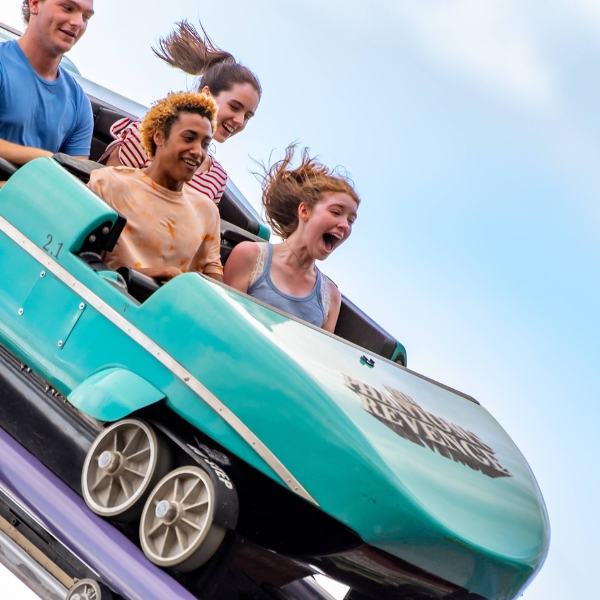
PHANTOM'S REVENGE -
2001 to Present
SKYROCKET - 2010 to Present